A Commentary on the Gospel of Matthew by Craig S. Keener
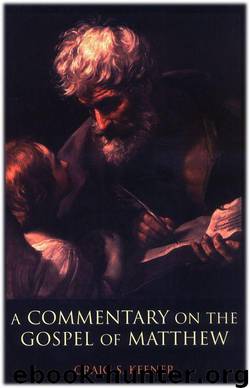
Author:Craig S. Keener [Keener, Craig S.]
Language: eng
Format: mobi
Tags: Religion, Christianity, NM, Reference, Bible Commentary
ISBN: 9780802838216
Google: sWzhEdBZOp4C
Amazon: 0802864988
Barnesnoble: 0802864988
Goodreads: 1167273
Publisher: Eerdmans Pub Co
Published: 1999-06-15T04:00:00+00:00
The Greatest Is the Child (18:1-5)
Cf. Mk 9:33-37; Lk 9:46-48; Jn 13:20. Here Jesus begins the fourth discourse in Matthew, addressing relationships in the church, which is the community of the kingdom (18:1-35). The disciples are concerned with an issue naturally prominent in status-conscious Mediterranean Judaism (Dalman 1929: 65; Harrington 1982: 73; Anderson 1976: 233): Who will be greatest in the kingdom (18:1; cf. 5:19; 20:26; 23:11)?1 Jesus declares that the kingdom belongs to children (cf. 19:14) — to those lowly in status.
Early Judaism clearly emphasized humility (cf., e.g., Jos. Ant. 3.212; ARN 38A; 41, §11 IB; b. Sota 4b-5a; Gen. Rab. 1:5), both in stories about the early Pharisaic sages (e.g., ARN 15A; 29, §§60-62B; p. Sanh. 6:6, §2) and stories of later rabbis (e.g., p. Ta'an. 4:2, §§8-9; Num. Rab. 9:20; Deut. Rab. 3:6). Such humility was often expressed toward those in positions of greater power (m. 'Abot 3:12; b. Meg. 28a; Ta'an. 20b), but those in power dare never become too arrogant themselves (e.g., Sifre Deut. 38.1.4; ARN 39A; p. Ta'an. 4:1, §14). At the same time Jesus' example of the child was even more dramatically counter-cultural than many of these rabbinic sentiments. Some Tannaim opined that one should begin with the greatest when extolling greatness (Sifra Shemini Mekilta deMilium 99.6.1). Scholars often thought that others should serve them (see comment on 23:7-11); for a certainly hyperbolic example, those who did not serve scholars, including serving them food, could warrant death (ARN 27, §56B)! Likewise, any student who was so presumptuous as to offer a legal decision in front of his teacher might be struck dead (Sifra Shemini Mekilta deMilium 99.5.6; Pesiq. Rab Kah. 26:6/7). Matthew's Jesus may not invert all social power structures in practice, but his rhetoric and example certainly challenge his audience to a more radical consideration of humility than was customary.
First, status in the kingdom is often inversely proportional to status in the world (18:1-4). Ancient moralists regularly trotted forth models of heroes and statesmen for their students to imitate; Jesus instead points to a child. More so then than today, children were powerless, without status and utterly dependent on the parents (Harrington 1982: 74; Hobbs 1990). On one hand, parents loved their children (cf. Arist. N.E. 8.12.2-3, 1161b; Diog. Laert. 7.1.120) and townspeople probably showed their "openness" to neighbors by letting other children pass through one's home and workplace (Malina 1981: 77-78; cf. the LCL introduction to Epictetus, p. xix). On the other hand, perhaps due to the high infant mortality rate among rural peasants (cf. CIJ passim, e.g., 1:308, §399), ancient Mediterranean parents sometimes may have been slower than are their modern Western counterparts to attach themselves too deeply to their younger children (Dixon 1988: 113). Yet disciples must imitate such people of no status, people who recognize their dependence.2 To "turn" reflects the Jewish concept of repentance (e.g., Jer 34:15); such a saying about conversion may also stand behind (hence be attested in) John 3:3, 5 (Witherington 1992: 64; cf. Pryor 1991).
Download
This site does not store any files on its server. We only index and link to content provided by other sites. Please contact the content providers to delete copyright contents if any and email us, we'll remove relevant links or contents immediately.
| New Testament | Old Testament |
The Five People You Meet in Heaven by Mitch Albom(3627)
The Secret Power of Speaking God's Word by Joyce Meyer(3406)
Real Sex by Lauren F. Winner(3061)
Name Book, The: Over 10,000 Names--Their Meanings, Origins, and Spiritual Significance by Astoria Dorothy(3010)
The Holy Spirit by Billy Graham(3000)
0041152001443424520 .pdf by Unknown(2892)
How The Mind Works by Steven Pinker(2862)
ESV Study Bible by Crossway(2812)
Ancient Worlds by Michael Scott(2720)
Churchill by Paul Johnson(2634)
The Meaning of the Library by unknow(2625)
The ESV Study Bible by Crossway Bibles(2580)
The Gnostic Gospels by Pagels Elaine(2564)
MOSES THE EGYPTIAN by Jan Assmann(2450)
Jesus by Paul Johnson(2406)
City of Stairs by Robert Jackson Bennett(2397)
The Complete Dead Sea Scrolls in English (7th Edition) (Penguin Classics) by Geza Vermes(2313)
The Nativity by Geza Vermes(2248)
Ancient Near Eastern Thought and the Old Testament by John H. Walton(2243)
